The FIFA 2026 World Cup Created a New Benchmark for Sports Media Success
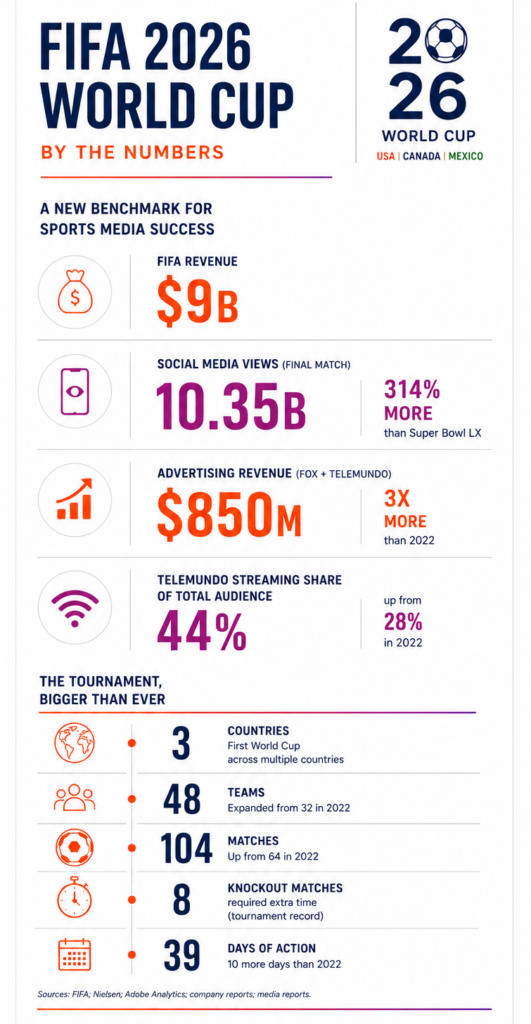
The 2026 World Cup was one for the ages. The tournament was bigger than ever, expanding from 32 teams to 48 and growing from 64 matches to 104 played across multiple countries for the first time. It was arguably the best World Cup yet, with the top four ranked teams making the semi-finals for the first time, and eight matches requiring extra time, tying the tournament record for the most knockout matches to go past regulation in a single World Cup. The tournament also created a new benchmark for sports media success across broadcast, streaming, and social media.
A Financial Windfall
By every standard, the World Cup generated a financial windfall for media, advertisers, and FIFA itself. FIFA earned an estimated $9 billion, up from $7.6 billion from the 2022 tournament.
- Audience viewership numbers broke records across broadcast and streaming. The final match between Spain and Argentina was the most-watched soccer telecast in U.S. history, and U.S. viewership of all matches rivaled that of marquee NFL matches across broadcast and streaming. The final also generated 10.35 billion social media views, 314% more than Super Bowl LX did.
- Fox and Telemundo were projected to generate a combined $850 million in advertising revenue, nearly triple the $282 million to $287 million the two networks booked in 2022.
The thrilling nature of the games themselves contributed to the historic financial windfall. The nature of the viewing experience also played a major role, too.
The New Viewing Experience
The 2026 World Cup delivered more action on the field over 39 days (10 more than the 2022 World Cup) and the introduction of hydration breaks that created advertising opportunities. In addition, a broadcast/digital universe of viewing experiences kept fans engaged in more ways than one.
Fox One streamed all 104 matches in English and added more than 1 million new subscribers in the tournament’s first week alone, the platform’s second-biggest sign-up week ever behind the start of NFL season. Peacock and Telemundo covered the full tournament in Spanish, and for some of Mexico’s biggest matches, the streaming audience measured by Adobe Analytics topped the Nielsen-measured broadcast number, reportedly a first for a men’s World Cup. Telemundo’s streaming share of its total audience grew from 28 percent in 2022 to 44 percent in 2026. Streaming grew alongside record-breaking broadcast numbers rather than pulling audience away from them.
FIFA stayed in the companion business. FIFA.com and the official app handled scores, schedules, and clips. Full match rights sat with the territorial broadcasters and streamers who paid for them. Social media closed that loop. FIFA’s Preferred Platform agreement with TikTok built an official hub, a creator program, and short authorized live windows into one place, letting a fan watch the opening minutes of a match on their phone before a link sent them to Fox, Telemundo, or Peacock for the rest of it.
Love them or hate them, the FIFA-mandated a three-minute hydration breaks turned the matches into a de facto four-quarter format. The built-in pauses gave broadcasters something soccer had never offered in a formalized way, a guaranteed mid-half window to run a commercial pod, cut to a tactics board, or drop in a sponsor-backed replay package. Broadcasters charged premium rates for these slots. For example, 30-second commercials on Fox cost roughly $200,000 to $300,000, and up to $750,000 during United States matches. Fox earned at least $250 million from these mid-game windows. The breaks were criticized for interrupting the matches, but they also gave players a chance to rest and maintain their stamina.
Takeaways for Future World Cups
2026 set the price for 2030 before a single match is played. Rights fees, ad inventory, and platform strategy are all being built around what just happened this summer.
Bidding for the U.S. media rights to the 2030 FIFA World Cup is expected to start at $1 billion, with combined English- and Spanish-language packages potentially running $1.5 billion to $2 billion once FIFA sells the two languages together instead of splitting them.
A rights fee at that level raises how much revenue the sponsorship-and-streaming model has to generate. A buyer paying $1 billion or more needs more than 30-second spots inside match coverage. It has to sell bigger sponsorship packages, use the tournament to pull subscribers into a streaming product, and build shoulder programming that keeps fans inside an owned app between matches.
Netflix, YouTube, Apple, Amazon, and Disney have all been reported as interested parties for 2030 and 2034, alongside incumbents Fox and Telemundo. Every one of them wants the full audience journey, from a TikTok clip to a live stream to a replay to whatever keeps a viewer inside the platform after a match is done. The next negotiation decides who owns that journey end to end.
FIFA says it is reviewing the future of mandatory hydration breaks, but they are likely here to stay in sone form. Now that Fox has shown broadcasters can charge premium rates for a mandatory in-game pause, rights holders will look for other moments inside the match to build the same kind of inventory. Expect more branded segments during breaks, more sponsor-backed replay packages, and pricing built around specific in-match windows rather than the broadcast as a whole.
The 2026 World Cup demonstrated that streaming, social clips, and free ad-supported layers can share the rights system with linear television instead of undercutting it. Every 2030 bidder will need a plan for all of it, not just a television package. Morocco, Spain, and Portugal will host most of 2030’s matches at least five hours ahead of U.S. Eastern time, pushing games into daytime windows and cutting into the primetime advantage that powered 2026’s numbers in the United States. That difference raises the pressure on everything else. A rights holder that can’t match those primetime ratings will need stronger streaming numbers and stronger shoulder programming to make the math work on a fee that could double what Fox and Telemundo paid this time around.
The World Cup Will Capitalize on the Audience Economy
FIFA will keep selling World Cup rights the traditional way, tournament by tournament, territory by territory, to the highest bidder. Another opportunity for economic growth sits one level down, in what we call the Audience Economy, a model built on owning the direct relationship with a fan instead of selling access to a broadcaster in the middle. Fox, Telemundo, and whichever platform wins the 2030 package are bidding for more than a broadcast window. They’re bidding for the chance to turn a World Cup viewer into a subscriber, a first-party data point, and a repeat sponsorship target. Building and monetizing a direct fan relationship remains largely unchartered ground.